
We Know How to Measure Water. But Do We Know How to Notice It?
From the Water Response Atlas to the Water Listening Lab — exploring what might happen when observation becomes the beginning of our relationship with water.
We have become extraordinarily good at measuring water.
We can measure temperature, salinity, pH, turbidity, pollutants, rainfall, flow, tides and countless other indicators. Sensors can remain in waterways long after we have left. Laboratories can tell us things about a sample that our eyes could never detect. Vast datasets can describe the changing condition of rivers, oceans, wetlands and catchments with extraordinary precision.

This knowledge is essential.
But I keep returning to another question.
Do we actually notice water?
Not water as a resource, utility or environmental issue.
The water running along the gutter after rain.
The creek we cross on the way to work.
The ocean at the end of our street.
The condensation forming on a window.
The water arriving through our taps and disappearing almost immediately down a drain.
The tiny body of water held inside a single droplet.
Over the past several months, this question has begun changing the direction of my practice.
Before measurement, there is encounter
When I began the Water Response Atlas, the process was deliberately simple.
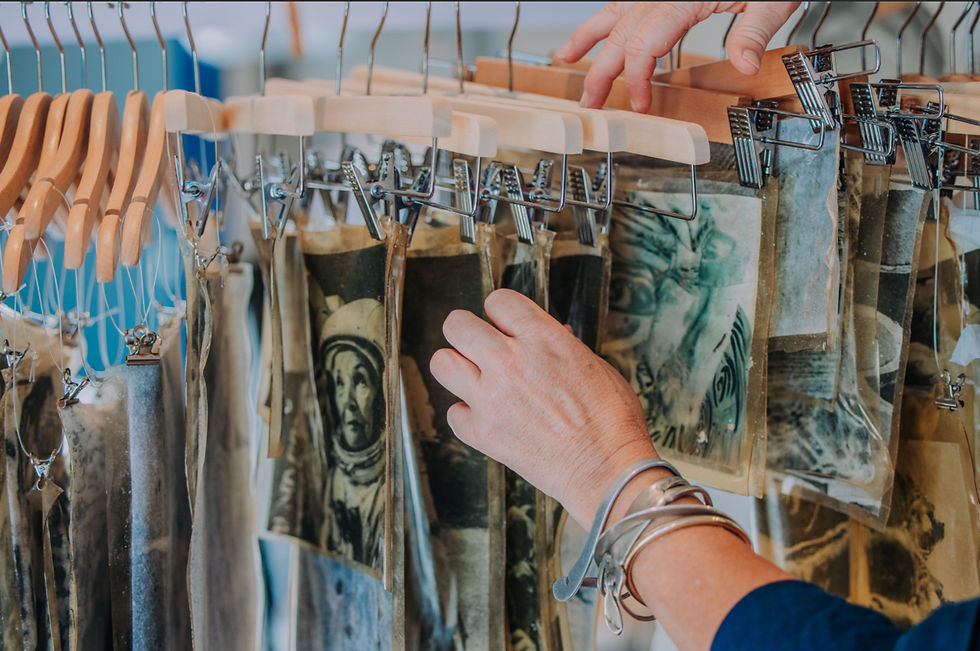
I collected water from different locations and began observing what happened when those waters entered my material practice.
Ocean water. Creek water. Rainwater. Canal water. Tap water. Stormwater.
Rather than attempting to make the water behave consistently, I became interested in difference.
What changed?
What remained?
What did the material reveal?
What happened when water from one place behaved differently from water collected somewhere else?
The resulting bioplastic plates, photographs and material experiments became a way of documenting those encounters.
But gradually I realised that the most important part of the process wasn’t necessarily the object I produced at the end.
It was the attention required to make it.
To collect water from a particular place is to begin noticing that place differently.
You notice whether it has rained.
You notice sediment.
Wind.
Light.
Movement.
Temperature.
Sound.
You notice what is floating on the surface and what disappears beneath it.
You begin asking questions.
And the water stops being simply water.
It becomes this water, from this place, at this moment.
That distinction has become increasingly important to me.
Listening changed the question
Recently, I began working with a hydrophone: a microphone designed to listen beneath the surface of water.
The first time you lower one into a body of water, something peculiar happens.
The familiar visual surface remains in front of you, but another environment opens through your headphones.
Movement.
Clicks.
Vibration.
Current.
Human infrastructure.
Biological activity.
Sounds whose sources may not immediately reveal themselves.
You realise very quickly that seeing a body of water and knowing a body of water are not the same thing.
And perhaps neither is listening.
Each is simply another way of paying attention.
That led me to the Water Listening Lab.
Not a laboratory in the conventional sense, and not a place where people are expected to arrive already knowing the correct terminology.
Instead, I am developing it as a space for curiosity.
A place where the first question can simply be:
What do you notice?
What if water literacy began with curiosity?
Imagine a child standing beside a creek.
Instead of beginning with a worksheet explaining what the creek is, we begin with an encounter.
They lower a hydrophone beneath the surface.
They listen.
They collect a tiny sample in a vial.
They hold it towards the light.
They use a magnifier.
They photograph a droplet.
They notice particles suspended inside it.
They draw something.
They write down a question.
Perhaps they return after rain and discover that the same creek is not quite the same creek.
Nothing spectacular has happened.
No enormous scientific instrument has been deployed. No one has been asked to memorise a list of facts.
And yet something significant may have begun.
The water has become particular.
It is no longer simply a creek.
It is this creek.
This sound.
This sample.
This observation.
This question.
And perhaps, eventually:
I wonder what will be different when I come back?
That question matters to me.
Because curiosity creates the possibility of return.
The Water Listening Lab
This is the thinking behind the Water Listening Lab I am now developing alongside the Water Response Atlas.
The tools can be remarkably small.
A vial.
A pipette.
A magnifier.
A notebook.
A phone or camera.
A hydrophone.
But the purpose isn’t really the equipment.
The Water Listening Lab isn’t about teaching people facts about water. It is about creating the conditions for people to become curious about the water already around them.
Science remains essential to understanding our waterways. The Lab isn’t intended to replace scientific measurement or environmental monitoring.
It occupies a different space.
A space before expertise.
Before the graph.
Before the dataset.
Before someone decides whether water is environmentally important enough to care about.
It asks whether observation, sensory experience, art and curiosity might help build the relationship from which deeper understanding can grow.
The Water Response Atlas asks: What does this water do?
The Water Listening Lab asks: What happens when we pay attention?
Together, they are becoming a framework for exploring how people might encounter water differently.
A Water Listening Lab in every region
Lately I have been carrying around a much larger question:
What would change if every child grew up learning to notice water?
It has led me to imagine what a distributed culture of water noticing might look like.
A Water Listening Lab in a library.
Another in a school.
Another beside a creek.
Another in a regional gallery.
Another on a coastline.
Each responding to its own water.
Each beginning with observation rather than assumption.
Each generating its own sounds, photographs, material responses, field notes, questions and discoveries.
A child on the Gold Coast should encounter different water from a child beside an inland river.
A coastal community should notice different things from a community experiencing drought.
A creek after heavy rain should not necessarily tell the same story as that creek three months later.
The differences are the point.
Over time, those encounters could contribute to something larger: a living Water Response Atlas made not only from water, but from the ways communities learn to encounter it.
Not one definitive description of Australian water.
Thousands of acts of attention towards it.
Attention is not conservation
I am careful about making grand claims for this work.
Listening to a creek will not repair it.
Photographing a droplet will not stop pollution.
Making an artwork from collected water will not restore an ecosystem.
Attention is not conservation. But it may be one of the conditions from which conservation becomes meaningful.
We protect things for many reasons: because science demonstrates their importance, because policy requires it, because ecosystems depend upon them.
But there is another, deeply human reason.
We protect things because they have become known to us.
Because we have spent time with them.
Because somewhere along the way, something that once belonged to the background of our lives became particular.
A creek.
A shoreline.
A wetland.
A sound beneath the surface.
A vial of water collected on an ordinary Tuesday.
Perhaps we have been starting too late
We spend enormous effort asking how people might be persuaded to care about water.
I am becoming interested in an earlier question.
What if we gave people more opportunities to fall in love with the water already around them?
Not water as an abstract environmental issue.
This creek.
This rainfall.
This shoreline.
This puddle.
This droplet.
This tiny vial of water held towards the light.
Look closely.
Listen.
Collect something.
Notice what changes.
Come back.
Ask another question.
Because listen closely enough, and an ordinary body of water stops being ordinary.
Perhaps that is where stewardship begins.


Comments