From Listening To Relationship
Updated: Oct 12

What if the world is not waiting to be understood?
By Juniper Sikora
I’ve been thinking about listening.
Not simply the act of hearing, but what it means to genuinely listen to something that doesn’t speak our language.
Water, for instance.
We live alongside it, move through it, depend upon it. We measure it, contain it, divert it, photograph it, analyse it. We know its chemical composition. We predict its tides. We build entire systems around controlling where it goes and what it does.
And yet, how often do we encounter water without wanting something from it?
Without needing it to provide information, become an image, demonstrate a phenomenon, or fulfil a purpose?
How often do we simply allow it to exist?
I’ve spent years exploring materials, observing their behaviour and becoming increasingly fascinated by what happens when things don’t behave as expected.
Water has become central to that curiosity.
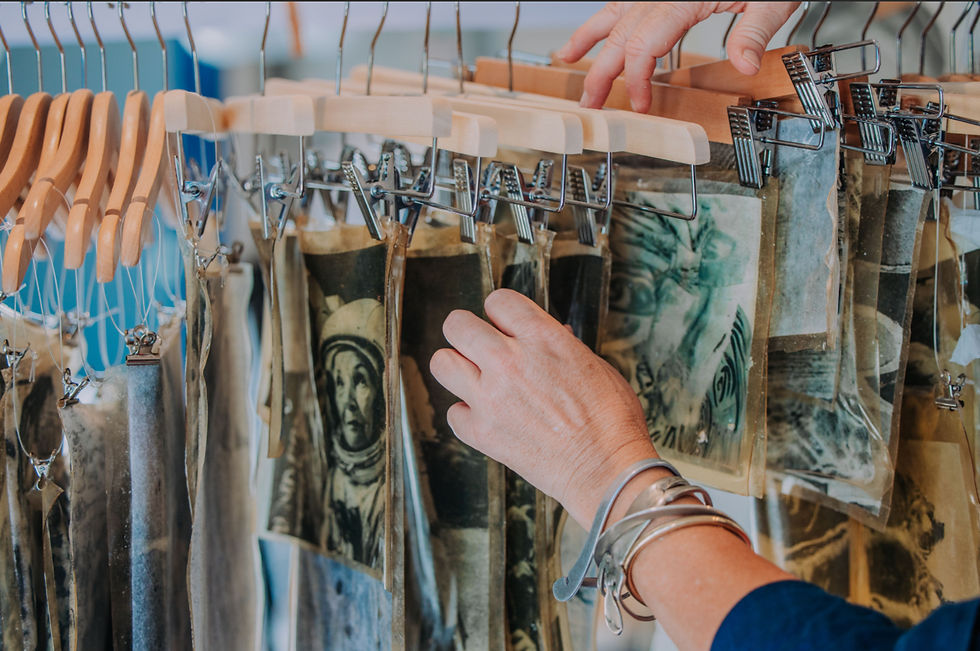
Through photography, experimental bioplastics, underwater sound and field observation, I’ve been investigating the ways water moves, transforms, resists and responds.
But lately, another question has been emerging.
What if listening isn’t about discovering more about water?
What if it’s about changing our relationship with it?

The limits of human attention
We tend to approach the natural world from a distinctly human position.
We observe. We classify. We interpret. We give things names.
Even our attempts to connect with nature often begin with the assumption that we are separate from it. That there is a world out there, and here we are, trying to understand it.
But we are not outside the systems we observe.
Our bodies are composed largely of water. Our breathing participates in exchanges with the atmosphere. Our movements disturb the environments we enter. Our presence changes things, whether we intend it to or not.
We are not simply witnesses.
We are participants.
And perhaps this is where a different kind of listening begins.
Not with the ears.
Not with technology.
Not even with knowledge.
But with the recognition that we are already involved.

Learning to be with water
I’m beginning to think about a different approach to my artistic research.
One that begins not with collecting, recording or documenting, but with relationship.
Before the hydrophone enters the water.
Before the camera is lifted.
Before a sample is collected.
There is an encounter.
A moment in which nothing needs to be produced.
No evidence gathered.
No discovery made.
No outcome anticipated.
Just the possibility of paying attention.
This sounds simple.
It isn’t.
We have become extraordinarily skilled at turning our encounters with the world into something useful.
Even curiosity can become a form of extraction. We arrive, gather what interests us, and leave.
But what happens if we stay?
If we allow ourselves to become uncertain?
If we resist the urge to immediately explain what we are experiencing?
Perhaps we begin to notice something other than what we came looking for.
Perhaps we become aware of how much we habitually overlook.
And perhaps the encounter begins to change us.

Water does not obey the plan
One of the most important things experimental materials have taught me is that control is often an illusion.
I can prepare a bioplastic mixture with precision, introduce water from a particular location, carefully establish the conditions and anticipate a result.
And then the material does something else.
It contracts unexpectedly. It forms an unfamiliar surface. It fractures, separates, curls or transforms in ways I hadn’t imagined.
For a long time, artistic practice has celebrated the ability to master materials.
But I’m increasingly interested in what happens when mastery is no longer the objective.
When the material is allowed to influence the direction of the work.
When the unexpected isn’t treated as a failure.
When the artist’s role shifts from imposing an outcome to responding to what emerges.
Water does not obey the plan.
And perhaps it shouldn’t have to.

Beyond the human
There is another dimension to this question.
The world is continuously responding to itself in ways that exist beyond ordinary human perception.
Fish detect movements and pressure changes in water through sensory systems unlike our own.
Plants respond to moisture, light, chemical signals and changes in their surroundings.
Water carries vibrations that our ears cannot hear without instruments.
Materials expand, contract and transform in response to environmental conditions we may barely notice.
These are not necessarily forms of listening as humans understand the word.
But they reveal something important.
Human perception is not the measure of everything that exists.
We experience only a small part of an immensely complex world of signals, relationships and responses.
What would happen if we approached that world with greater humility?
Not assuming that everything meaningful must first become understandable to us.
Not expecting the living world to communicate on our terms.
But recognising that our inability to perceive something does not mean nothing is happening.
Before asking what the planet might be communicating beyond our senses, perhaps we need to question the relationship from which we are asking.

From observation to reciprocity
Listening is often described as receiving information.
But I wonder whether deeper listening requires something more.
A willingness to be affected.
To reconsider an assumption.
To change our behaviour.
To allow an encounter to have consequences.
If I spend an hour beside a creek and leave with beautiful photographs, I have documented something.
If I leave noticing the world differently, something else has happened.
And if that altered awareness changes how I return, how I work, what I take, what I leave undisturbed, or how I care for that place, then listening has begun to become a relationship.
Reciprocity doesn’t mean pretending water has human intentions or that nature exists to teach us lessons.
It means recognising that our encounters carry responsibilities.
That attention is not ownership.
That understanding is not entitlement.
And that not everything we encounter needs to become something we possess.

A different beginning
Within my ongoing Water Response Atlas research and Water Listening Lab, I’m beginning to explore a methodology that moves from listening towards relationship.
It begins with a deceptively simple proposition:
Learn to be with water.
Not to analyse it.
Not to capture it.
Not even to understand it immediately.
To encounter it without demanding anything in return.
From there, other possibilities begin to emerge.
We can learn to respond rather than control.
We can question the limits of human perception.
We can investigate how other organisms sense their environments.
We can use sound, photography, materials and technology to make processes beyond our ordinary senses encounterable.
But the order matters.
Relationship first.
Then perception.
Then translation.
Otherwise, we risk developing increasingly sophisticated ways of observing the planet without fundamentally changing how we inhabit it.
And perhaps that is one of the most urgent questions of our time.
Not simply how much more we can discover about the living world.
But whether we can learn to exist within it differently.
I don’t know where this inquiry will lead.
And increasingly, I think that’s important.
I’m interested in what happens when attention becomes an artistic material in its own right.
When listening is no longer simply a method of gathering information, but a way of entering into relationship.
When the question changes from What can I discover here? to How am I participating in what is happening here?
Perhaps we have spent so long trying to make the world intelligible to us that we’ve forgotten to ask what it might mean to become more attentive to the world.
The world is not silent.
We are only listening in human.
And perhaps the deepest listening begins when we no longer expect the world to speak our language.
Juniper Sikora
Water Response Atlas / Water Listening Lab



Wow Juniper… so taken/fascinated by your findings and feelings about our relationship with the environment.. incredible writing, totally thought provoking! Thank you for sharing. We do need to understand our very connected relationship between the natural world, humanity and science. Brilliant Juni xo